Why Construction Materials Are Difficult to Secure
- High density — bricks, blocks, bagged cement, tiles, and aggregates concentrate a great deal of weight in a small space, so small movements create large forces.
- Loose or stacked units — palletised bricks, bags, and boards can break apart or slide unless they are first unitised and then secured as a single load.
- Long and irregular shapes — pipes, timber, panels, and prefabricated sections are long, flexible, or uneven, and need lashing along their length to stop them sliding or bending.
- Fragile and finished surfaces — glass, cladding, tiles, and finished panels are easily chipped or scratched by straps and by each other.
- Mixed road, rail, and sea routes — materials are often moved by truck to site after a sea voyage, facing braking, cornering, and rough site roads.
DunLash Solutions by Construction Material
| Material | Recommended DunLash solution |
|---|
| Palletised bricks, blocks, and pavers | Composite polyester strapping to unitise pallets + dunnage air bags to fill voids |
| Bagged cement, plaster, and aggregates | Composite polyester strapping to unitise + blocking with dunnage bags + container desiccants to prevent caking |
| Timber, boards, and panels | Top-over polyester lashing + edge protectors at contact points + anti-slip mats |
| Pipes, profiles, and long sections | Direct lashing to lashing points along the length + blocking at the ends |
| Glass, tiles, and finished cladding | Strapping with edge protectors + blocking and void filling to prevent contact damage |
| Prefabricated and modular components | Direct lashing with high-MSL polyester lashing + anti-slip mats + edge protectors |
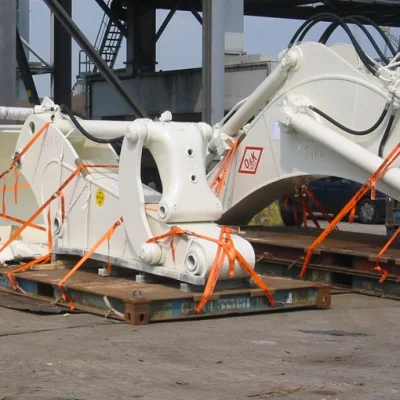
Structural steel, earthmoving equipment, and construction machinery have their own dedicated guidance: see steel and metal cargo securing and machinery and equipment cargo securing.
Woven Polyester Lashing for Heavy Building Materials
DunLash woven polyester lashing provides SGS certified system breaking strengths from 2,850 daN to 13,850 daN. Its Maximum Securing Load (MSL) is 50% of the system breaking strength — up to 6,925 daN per lashing for the DunLash 750.
| DunLash Lashing | System Breaking Strength |
|---|
| DunLash 105, 32mm | Up to 2,850 daN — palletised goods and lighter machinery |
| DunLash 200, 42mm | Up to 9,580 daN — medium equipment and structural steel |
| DunLash 750, 50mm | Up to 13,850 daN — heavy machinery and project cargo |
Strapping, Dunnage, and Moisture Protection
DunLash composite polyester strapping in widths from 13mm to 32mm unitises pallets and bundles of building materials so they behave as one load, with system breaking strengths from 529 daN to 2,771 daN.
Dunnage air bags from 90×120cm to 90×225cm fill the gaps between pallets and at the container doors, stopping heavy loads from gathering momentum.
Cement, plaster, and other hygroscopic materials can absorb moisture and cake during a sea voyage. DunLash Ultra container desiccants absorb 250% or more of their weight in moisture, helping to prevent condensation damage to bagged products and packaging.
Compliance and Safe Loading
Construction materials shipped in containers must be packed and secured in line with the IMO/ILO/UNECE CTU Code. Our CTU Code guide explains the requirements, and our force calculation guide shows how to work out the number of lashings a load needs. For a full overview of blocking, bracing, friction, and lashing, see cargo securing methods.