Why Cargo Moves in Transit
Cargo shifts because transport is never still. Trucks brake and corner, trains are shunted and coupled, and ships roll, pitch, and heave in a seaway. Each movement creates dynamic forces that act on the cargo as a multiple of its own weight. If the securing method cannot resist those forces, the cargo slides, tips, or breaks loose — damaging itself, other cargo, the container, and sometimes the vehicle or vessel.
The CTU Code sets out the forces cargo must withstand for each transport mode. Our cargo securing force calculation guide explains those forces and shows, step by step, how to calculate the securing force your load requires.
Method 1 — Blocking
Blocking means placing cargo so that it cannot move: tight against the container walls, against other cargo, or against fixed blocks. A well-blocked load has no gaps for cargo to gather speed in, which is why blocking is usually the first and most effective method.
Where gaps cannot be avoided — between pallet rows, at the container doors, or around irregular cargo — they must be filled. Dunnage air bags inflate to fill the void and hold the load in place, in sizes from 90×120cm to 90×225cm and AAR Levels 0, 1, and 2. The CTU Code also sets out how voids should be handled; see our explanation of the 15cm rule in the CTU Code guide.
Method 2 — Bracing
Bracing uses rigid structures — timber shoring, cradles, or frames — to hold cargo against a strong point of the container or vehicle. It is common for heavy, concentrated, or irregular cargo such as machinery skids, coils, and cylindrical items, where the cargo shape prevents direct blocking.
Bracing is usually combined with lashing: the bracing stops the cargo moving in one direction, while lashings hold it down and resist forces in the others. Where bracing is impractical, high-strength lashing and dunnage bags can often achieve the same result with less material and faster loading.
Method 3 — Friction
Friction between the cargo and the floor resists sliding. The higher the friction, the less additional securing the load needs. Smooth, wet, or oily surfaces offer very little friction, which is why cargo on steel decks, plastic pallets, or painted floors slides easily.
Anti-slip cargo mats placed under the load raise the friction coefficient to μ ≥ 0.7, tested to VDI 2700. Higher friction reduces the number of lashings needed to secure the same load — a direct saving in materials and loading time — and is particularly effective when combined with top-over lashing.
Method 4 — Lashing
Lashing ties the cargo to the lashing points of the container, flat rack, truck, or deck. There are two main types, and they work in different ways:
| Lashing type | How it works | Typical use |
|---|
| Direct lashing (loop, diagonal, straight) | The lashing connects the cargo directly to a lashing point. Its holding capacity is based on the lashing’s Maximum Securing Load (MSL). | Heavy machinery, vehicles, project cargo, break-bulk |
| Top-over (indirect) lashing | The lashing passes over the cargo and presses it down onto the floor, increasing friction. Its effect depends on the pre-tension applied. | Palletised and stackable cargo, often combined with anti-slip mats |
The Maximum Securing Load (MSL) is the load a lashing system may carry in service, and it equals 50% of the system breaking strength. DunLash woven polyester lashing provides SGS certified system breaking strengths of up to 13,850 daN, giving an MSL of up to 6,925 daN per lashing. Full figures are on our polyester lashing specifications page.
| DunLash Lashing | System Breaking Strength |
|---|
| DunLash 105, 32mm | Up to 2,850 daN — palletised goods and lighter machinery |
| DunLash 200, 42mm | Up to 9,580 daN — medium equipment and structural steel |
| DunLash 750, 50mm | Up to 13,850 daN — heavy machinery and project cargo |
Where lashings pass over sharp cargo edges, edge protectors prevent the lashing from being cut or abraded and spread the load across the cargo surface.
Unitising — Making Many Items Act as One
Loose cartons, bags, or small items cannot be lashed individually. Strapping them into a single unit first means the unit can then be blocked, braced, or lashed as one load. DunLash composite polyester strapping in widths from 13mm to 32mm provides system breaking strengths from 529 daN to 2,771 daN for unitising pallets, bundles, and bales.
Dynamic Cargo Securing — Why Elastic Lashing Helps
Transport forces are dynamic: they arrive as repeated shocks and vibrations rather than a single steady pull. Rigid securing such as chains transmits every shock straight to the cargo and the lashing points, and can loosen as the load settles. Woven polyester lashing stretches slightly under load and recovers, absorbing shock and keeping tension on the cargo as it settles — one reason polyester lashing systems are widely used for containerised and break-bulk cargo.
Combining Methods by Cargo Type
| Cargo type | Typical securing combination |
|---|
| Palletised goods in containers | Blocking + dunnage air bags in voids + strapping to unitise pallets |
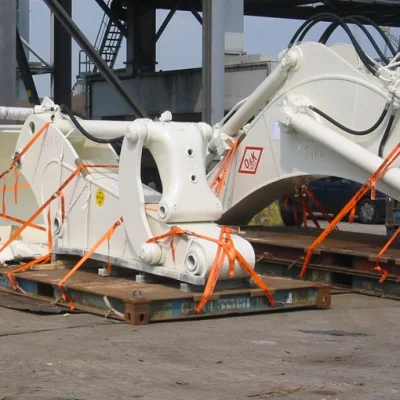
| Machinery and equipment | Direct lashing to lashing points + anti-slip mats + edge protectors |
| Steel coils, plate, and structural steel | Bracing or cradles + direct lashing with high-MSL polyester lashing |
| Drums and IBCs | Blocking + strapping to unitise + dunnage air bags in remaining voids |
| Mixed or irregular loads | Blocking where possible + top-over lashing + anti-slip mats |
| Flat rack and open-top cargo | Direct lashing to the flat rack’s lashing points + edge protectors |
DunLash supplies products for each of these methods for cargo securing in steel and metal, machinery and equipment, and mining and heavy industry applications.
How to Prevent Cargo Shifting — Checklist
- Calculate the forces your cargo must withstand for each transport mode.
- Block the cargo first and fill every void that blocking cannot close.
- Use anti-slip mats where cargo sits on smooth or low-friction surfaces.
- Unitise loose items before lashing them.
- Select lashings by MSL, not by breaking strength alone, and use enough of them for the calculated force.
- Protect lashings at sharp edges and check tension before the container is closed.
- Follow the CTU Code and keep a record of how the load was secured.
For on-site support, DunLash offers cargo securing inspection and training, including pre-shipment assessments and hands-on training for packing teams.