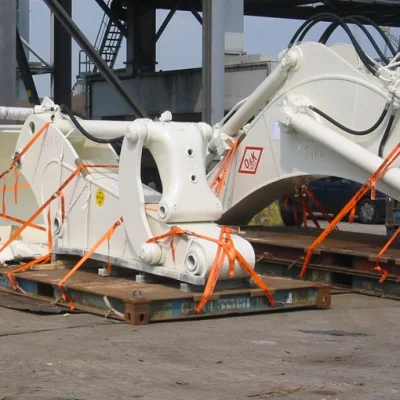
What Is a Flat Rack?
A flat rack is a 20ft or 40ft shipping container made up of a reinforced floor and two end walls, which on many units fold down flat. With no roof or side walls, flat racks carry cargo that is too wide, too tall, or too heavy for a closed container — and they travel on container ships, trucks, and trains like any other container. Flat racks have lashing points built into the floor and frame for securing the load.
Cargo Commonly Shipped on Flat Racks
- Heavy machinery — mining, construction, and agricultural equipment.
- Industrial and project cargo — transformers, generators, tanks, and plant components.
- Steel and long cargo — structural steel, coils on cradles, pipes, and profiles.
- Vehicles and boats — wheeled, tracked, and hull cargo that does not fit inside a closed container.
Why Lashing Is Critical on a Flat Rack
- No walls to block against — sideways and longitudinal forces must be resisted entirely by lashing and friction.
- Exposure to weather — flat-rack cargo is exposed to rain, spray, and sun, so lashing materials must keep their strength in wet and hot conditions.
- Heavy, concentrated loads — machinery and project cargo place high loads on a small number of lashing points.
- Sharp edges — steel frames and machinery edges can cut or abrade lashings that are not protected.
- Several transport modes — the same lashing must hold during the truck journey to port, crane handling, and the sea voyage.
DunLash Lashing for Flat Rack Cargo
DunLash woven polyester lashing provides SGS certified system breaking strengths from 2,850 daN to 13,850 daN. The MSL — the load a lashing system may carry in service — is 50% of the system breaking strength.
| DunLash Lashing | System Breaking Strength |
|---|
| DunLash 105, 32mm | Up to 2,850 daN — palletised goods and lighter machinery |
| DunLash 200, 42mm | Up to 9,580 daN — medium equipment and structural steel |
| DunLash 750, 50mm | Up to 13,850 daN — heavy machinery and project cargo |
Polyester lashing is lighter and easier to handle than chain, does not rust, and stretches slightly under load to absorb shock. Full figures are on our polyester lashing specifications page.
How to Lash Cargo on a Flat Rack
- Calculate the securing force — use the cargo weight and the CTU Code forces to work out the total MSL needed in each direction. See our force calculation guide.
- Place the cargo centrally — keep the centre of gravity over the middle of the flat rack and within its rated load distribution.
- Increase friction — place anti-slip mats (μ ≥ 0.7, VDI 2700) between the cargo and the floor.
- Use direct lashing — lash the cargo to the flat rack’s lashing points in pairs, opposing each other forward, aft, and to each side.
- Protect every edge — fit edge protectors wherever a lashing passes over a sharp corner.
- Tension and check — tension each lashing with a suitable tensioner, and re-check tension before the flat rack leaves the yard.
Never let the total load on a lashing point exceed the point’s rated capacity. For more on blocking, friction, and lashing types, see cargo securing methods.